Portfolio
Case study 03
Conducted extensive research to redesign Hall Pass, Hall Management Group’s customer loyalty restaurant rewards system.
Role
UX Designer & Researcher
Timeline
7 weeks / September 2025
Tools
Figma
Scope
Professional / Academic Portfolio

Billy
ORIGINAL EXPERIENCE

REDESIGNED Interface
Phase 01
Context & The Challenge
A critical drop-off problem hiding in plain sight
Background
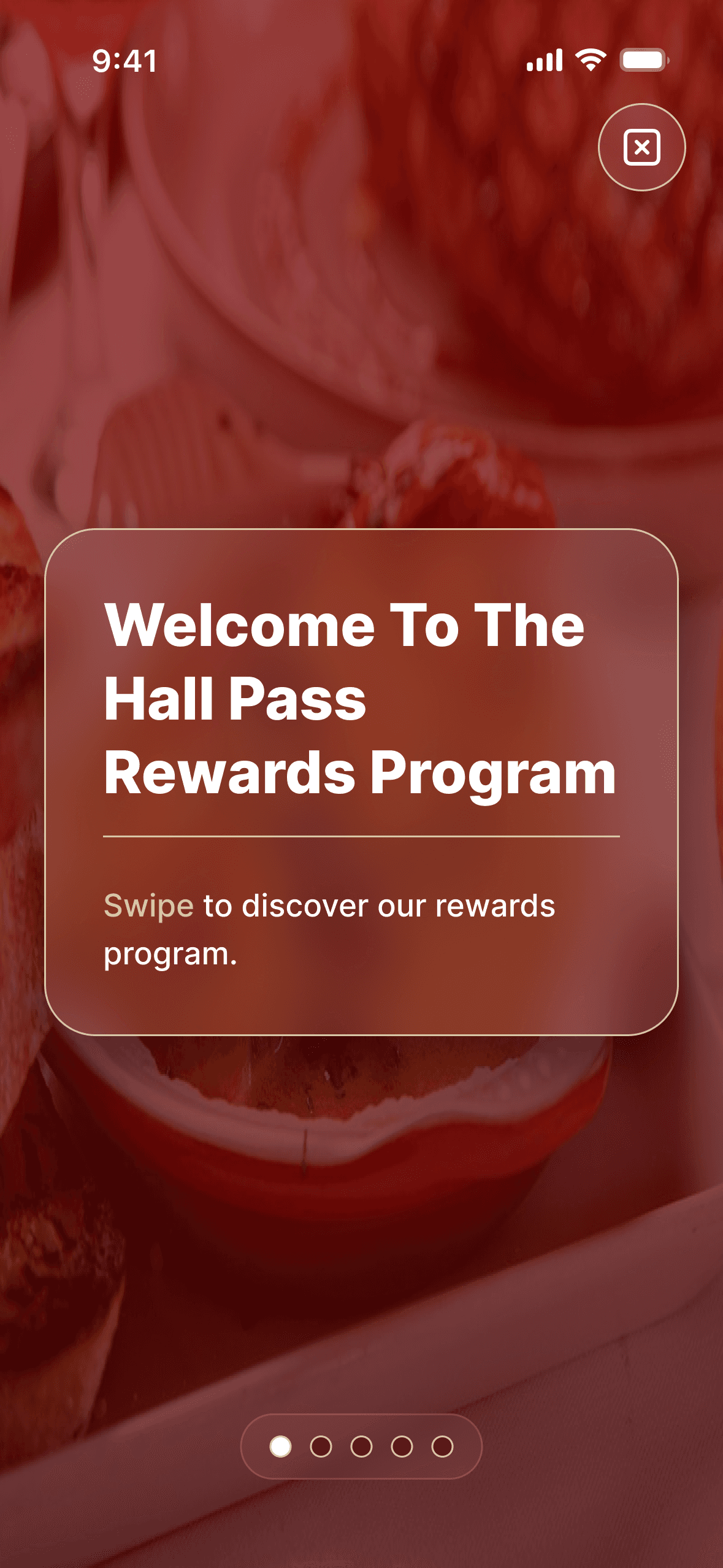
Hall Pass Rewards is the mobile loyalty program for Halls Chophouse. To align the digital experience with its high hospitality standards, I conducted a 7-week redesign focused on automated point tracking, immediate sensory feedback, and streamlined navigation.
Problem Statement
Halls Pass users across various life stages need an effortless, immediate rewards system to replace time-consuming manual processes that disrupt their primary dining goal: enjoying quality time with family while feeling valued for their loyalty.
Primary KPI goal
Target adoption of automated QR scanning over manual point entry.
Phase 02
Discovery & Empathize
Understanding the friction holding back premium dining rewards
I analyzed app store review data alongside a direct competitive audit to uncover environmental constraints—like low-light dining rooms and family interactions—that impact how loyalty members use the app.
Research methods
Reviews
Critical pain points identified by frequency
6 Apps
Direct and indirect restaurant loyalty programs evaluated
3 Profiles
User personas developed across varying guest life stages
7 Weeks
Total timeline dedicated to this redesign initiative
Core user pain points
From Secondary Research
01
Manual receipt tracking bottlenecks
Multi-step receipt submission causes friction at the table, disrupting hospitality and eroding guest trust.
02
Ambiguous balance validation feedback
Lack of immediate visual confirmation creates uncertainty, forcing users to navigate through opaque menus instead of focusing on their meal.
03
Flawed accessibility in low lighting
Low-contrast typography and poor responsiveness make the app difficult to navigate in dim restaurant environments.
Phase 03 & 04
Define & Ideate
Turning research noise into a single, guiding design question
How Might We
This statement synthesized app store friction data with competitive analysis, establishing the north star before interface sketching began.
Mapping Real-World Friction to Hands-Free Processing
Each real-world user friction map directly to an automated processing step, resolving table anxiety into an instant, hands-free loyalty credit.
ANXIETY LAYER 01
The Time-Pressured Guest
ANXIETY LAYER 02
Impaired Visual Environment
ANXIETY LAYER 03
Fragmentation of Steps
AUTOMATED SCANNING & PROCESSING ENGINE
HIGH-CONFIDENCE LOYALTY TRANSACTION OBJECT
Instant Point Validation (Predicted)
ZERO MANUAL STEP INTERACTION
OPTIMIZED LOW-LIGHT INTERFACE DELIVERABLE
Phase 05 & 06
Design, Prototype & Test
Translating heritage hospitality values into high-fidelity digital interfaces
I converted the architectural logic into an accessible design system focused on high-contrast visual hierarchies and instant feedback loops, building a mobile prototype equipped with a dedicated contrast mode tailored for low-light dining environments.


Key Feature
Tableside Hierarchy & Quick Actions
User Impact
Centralizing add and redeem functions via prominent top-level targets eliminates tableside friction and streamlines tracking.


Key Feature
Automated Validation Flow
USER impact
Transitioning from manual entry to automated QR scanning streamlined the user flow, removing navigation friction and reducing task time by half.
6
Apps audited
Direct & indirect
3
User personas
Varying life stages
Phase 07
Impact & Key Takeaways
Elevating the digital guest experience
Over 7 weeks, automated point-tracking, immediate sensory feedback, and streamlined navigation were introduced to restore guest trust without compromising tableside hospitality.


What I’d carry into the next project
01
Service Before Self
Aligning the digital ecosystem with real-world hospitality values ensures technology enhances the dining experience rather than detracting from it.
02
Immediate Sensory Feedback
Providing clear visual and tactile confirmation instantly restores guest trust and removes ambiguity.
03
Automated Infrastructure
Transitioning from complex manual workflows to automated receipt parsing and immediate feedback loops restores user confidence during service.
END OF CASE STUDIES
All work
© 2026 Streett Jacobs — All rights reserved